















The basics of biosecurity in poultry and livestock housing
Biosecurity is the set of measures that keep pathogens out of a site and stop them spreading once inside. This article covers zoning, traffic flow, downtime and personnel discipline.
Last updated:
This content is for education and information only. It is not a diagnosis, treatment or dosage recommendation and does not replace examination by a veterinarian. For treatment decisions, consult your veterinarian and the product’s approved label.
Biosecurity is the set of measures that stop disease agents entering a site and, once in, stop them spreading within it. Little of it needs expensive equipment. It is largely a matter of layout, discipline and consistency.
Its value comes from something awkward: biosecurity prevents disease that then never happens. The effect is invisible by nature, but every case that does not need treating is a case won. Because it reduces the need for antibiotics, it is also one of the most effective tools available for slowing resistance (see What is antimicrobial resistance?).
1. Zoning: clean and dirty areas
The foundation of biosecurity is dividing the site, mentally and physically, into a dirty and a clean zone.
The dirty zone is everything in contact with the outside world: the road, parking, the point where the feed lorry pulls in, the dead-stock collection point. The clean zone is where the animals are.
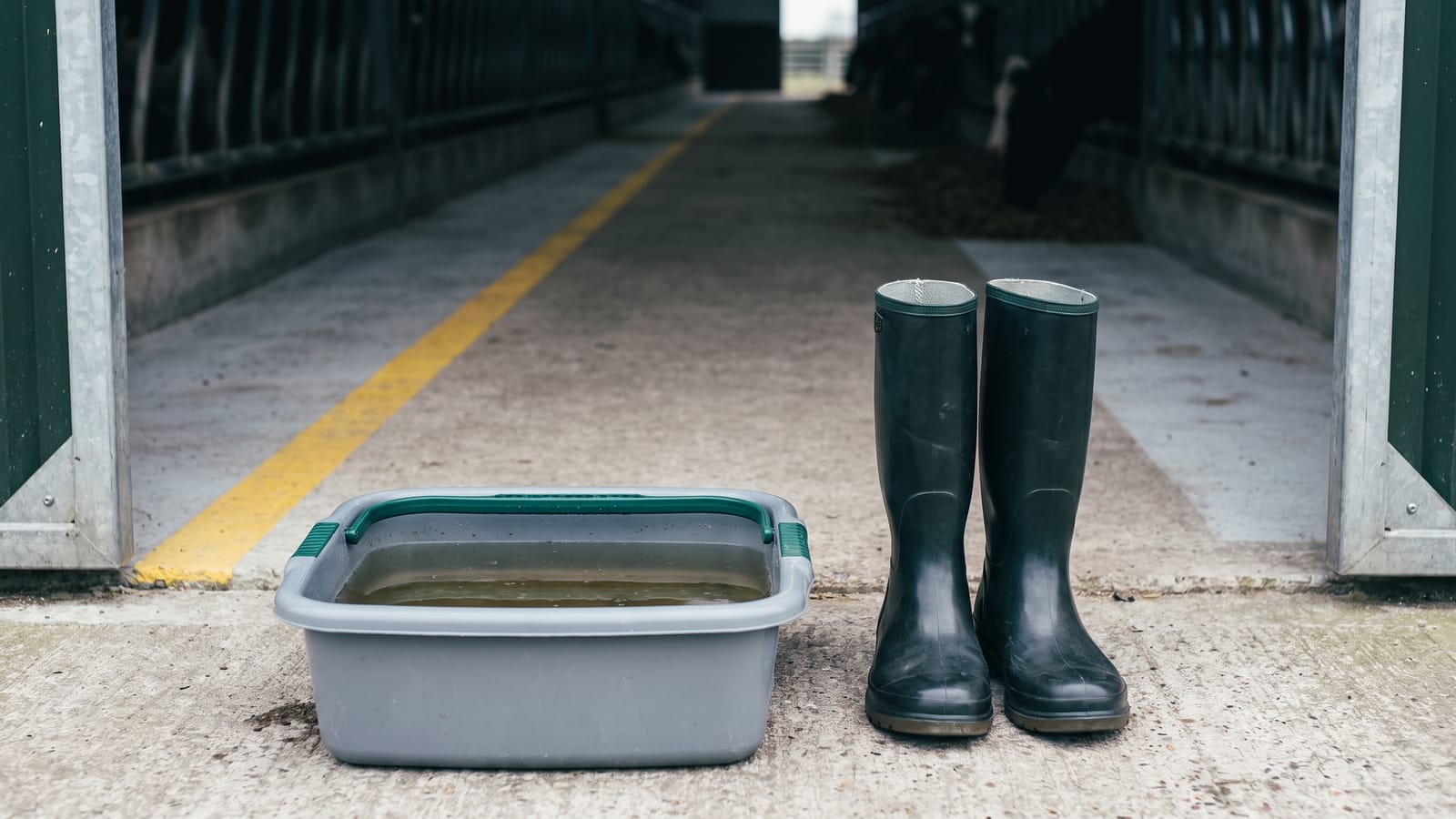
Between them there must be a clear, physical transition point. In practice this is usually a bench, a line or a threshold. Footwear and overalls change here: the person sits on one side, removes their boots, swings round to the other side and puts on clean boots. This simple “sit and swing” arrangement is the most practical way to cut transmission on foot traffic.
If everyone on site cannot say where the line is, there is no zoning.
2. Traffic flow: one direction
Movement around the site should be planned to run from clean to dirty, never the reverse.
In practice that means:
- Visit young animals first, older ones after.
- Visit healthy groups first; leave sick or suspect groups until last.
- Do not backtrack after entering a house; if you must, change clothing and footwear.
The same principle applies to equipment. Shovels, barrows, buckets and above all anything used for handling dead stock should not be shared between groups. Where sharing is unavoidable, cleaning and disinfection must come in between.
3. Personnel and visitor discipline
People are the most common way agents arrive on a site.
- Keep a visitor log: who, when, and which site they were on last.
- Apply a downtime rule. It is common practice to require a set interval before someone who has been on another livestock site may enter.
- Provide clothing and boots on site. A visitor arriving in their own boots is a risk even if those boots look clean.
- Insist on hand hygiene, especially when moving between groups.
- Your own staff’s animals at home are a risk too; personnel who keep poultry should declare it.
4. Rodent, wild bird and insect control
Rodents carry many agents, Salmonella prominent among them, and they target feed stores. Wild birds are a significant route of entry, including for avian influenza.
Practical measures: clean up feed spills immediately, keep feed stores closed, keep vegetation short around buildings, mesh windows and ventilation openings, run a regular rodent control programme, and deny wild birds access to feeders.
5. Cleaning, disinfection and downtime
Between-crop cleaning has three steps, and the order matters:
- Mechanical cleaning. Remove organic matter. Skip this and the disinfectant will not work; most disinfectants are inactivated by organic material.
- Washing and drying.
- Disinfection. Choose a product suited to the target agent and respect the contact time on the label. What matters is the right contact time, not a heavier dose.
Then comes downtime. This interval lets residual pathogen load decline naturally, and for many agents it is the single most effective step. Shortening it gives back what the cleaning achieved.
Water-line cleaning is frequently skipped, yet biofilm both harbours pathogens and can inactivate live vaccines. See Drinking water line hygiene and biofilm.
6. Stock entry and source management
Source animals from a single origin wherever possible. Groups from different origins bring their own flora and different immune histories with them.
Use a separate adaptation or quarantine area for new arrivals, and visit it last. An all-in/all-out system, by preventing different age groups from coexisting, is the strongest structural measure available for breaking pathogen cycles.
Where to start
The hardest thing about biosecurity is that it is never a one-off job. A short written protocol, a visible zone boundary at the entrance, and a visitor log that is actually kept are the three steps that make the biggest difference on most sites.
Build a biosecurity plan specific to your operation with the veterinarian who visits it.
References
- FAO, Biosecurity for Highly Pathogenic Avian Influenza
- WOAH, Terrestrial Animal Health Code, Chapter 6.5: Biosecurity procedures in poultry production
Educational only; not a diagnosis, treatment or dosage recommendation.