














Drinking water line hygiene and biofilm
Biofilm inside the drinker line harbours bacteria and undermines vaccines and products given in water. This article explains how biofilm forms and why line cleaning has to be a scheduled job.
Last updated:
This content is for education and information only. It is not a diagnosis, treatment or dosage recommendation and does not replace examination by a veterinarian. For treatment decisions, consult your veterinarian and the product’s approved label.
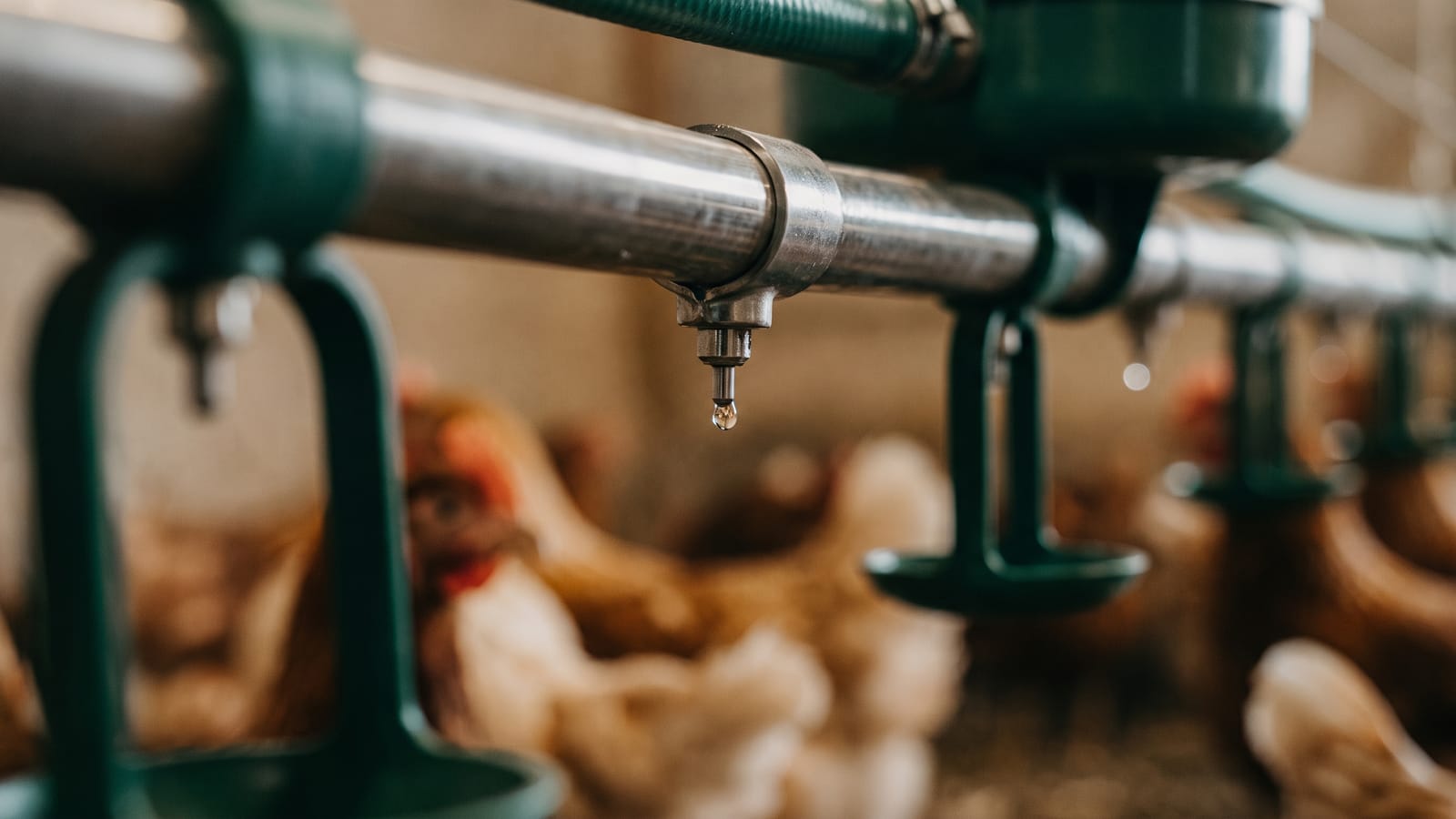
Water is the most consumed and least monitored input in poultry production. Even where the water arriving at the house is clean, the inside of the drinker line usually goes unexamined. The biofilm that forms there is both a reservoir of pathogens and an obstacle to anything delivered through the water.
What is biofilm?
Biofilm is a sticky polysaccharide layer produced by bacteria that have attached to the inner surface of the pipe. The bacteria live embedded within it.
Two properties matter. First, once attached to a surface, bacteria become far more resistant to disinfectants than they are free-floating; a normal dose of chlorine in the water does not reach the bacteria inside the biofilm. Second, biofilm continually sheds small fragments and releases bacteria into the water, so the line becomes a source of contamination in its own right.
What feeds biofilm?
The main accelerators of biofilm formation are:
- Sugar and organic matter. Vitamin, electrolyte and sugar-containing products given through the water are direct nutrition for biofilm. Not flushing the line after such products is among the most common mistakes.
- Low flow rate: the little-used sections at the end of a line are where biofilm is heaviest.
- Temperature. Warm water speeds formation; sections of line exposed to sun are at risk.
- Scale in hard water gives bacteria a surface to attach to, so mineral content counts too.
- Idle periods. A line left full of water between crops is ideal for biofilm.
The link with vaccination
This is biofilm’s most direct consequence. When live vaccines are given in water, residual disinfectant in the line inactivates the vaccine virus. The line therefore has to be cleared of disinfectant before water vaccination.
That creates a balancing problem: disinfecting the line continuously controls biofilm but causes trouble on vaccination day, while never disinfecting lets biofilm build. The answer is to plan the disinfection and vaccination schedules together. It is one of the most frequently missed answers to the question of why a vaccine appears not to work.
The same principle applies to other products given in water: deposits in the line can prevent even distribution across the flock.
What to do in practice
Between-crop line cleaning. When the house is empty, flushing the line with a high-concentration cleaner is the most effective way to strip biofilm mechanically and chemically. It can only be done with no birds present. Product choice and concentration must suit the pipe material.
In-crop maintenance. While the flock is in the house, daily line disinfection and regular flushing from the far end slow re-accumulation.
Flush after any product given in water. Flushing after a sugar, vitamin or electrolyte application is necessary to avoid leaving nutrition behind for the biofilm.
Pressure and flow. Reducing stagnant sections at the end of the line limits accumulation.
Monitor water quality. Samples from the source matter, but samples from the far end of the line matter just as much. The difference between the two shows what the line itself is contributing, and that difference is often surprising.
Why it gets neglected
The drinker line is invisible. The biofilm inside it is not noticed until the line is dismantled. Its effects, meanwhile, show up indirectly: in enteric cases, in weaker-than-expected vaccine responses, and in loss of flock uniformity.
If you are seeing unexplained gut problems or poor vaccine take, a water sample from the end of the line is a low-cost and frequently revealing step.
Plan your line cleaning programme, and how it fits your vaccination schedule, with the veterinarian who knows the flock.
References
- Swayne D.E. (ed.), Diseases of Poultry, Wiley-Blackwell
- Maharjan P. et al., Poultry water quality and biofilm management, Poultry Science
Educational only; not a diagnosis, treatment or dosage recommendation.