















How an egg is formed: 24 hours in the oviduct
An egg takes roughly 24 hours to form, from release of the yolk at the ovary to the finished shell. This article walks through the five sections of the oviduct and how long the egg spends in each.
Last updated:
This content is for education and information only. It is not a diagnosis, treatment or dosage recommendation and does not replace examination by a veterinarian. For treatment decisions, consult your veterinarian and the product’s approved label.
In the hen, an egg is the product of a journey of about 24 hours. It begins when the yolk leaves the ovary and ends when the shell is complete. Knowing how long each stage takes makes it far easier to work out which part of the process a shell-quality or internal-quality problem is likely to belong to.
The ovary: maturing the yolk
In female birds only the left ovary is functional. A chick hatches with thousands of primordial follicles in that ovary; only a very small proportion ever mature into yolks.
In a maturing follicle the yolk is laid down in layers over several days. At ovulation the follicle ruptures and the yolk is released into the mouth of the oviduct. That layered deposition is also why concentric rings are visible when a hard-boiled yolk is cut.
Infundibulum: capture and fertilisation
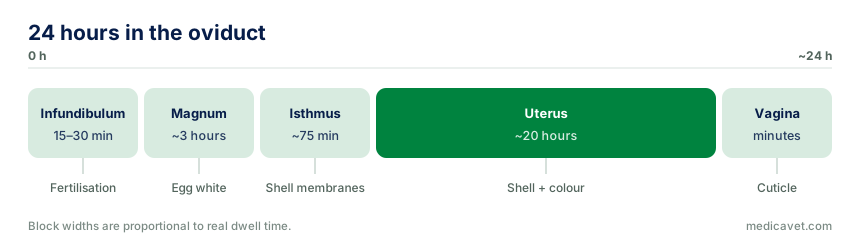
The yolk first drops into the funnel-shaped infundibulum, where it spends roughly 15–30 minutes.
The infundibulum does two jobs: it catches the ovulated yolk before it can escape into the body cavity, and it is where fertilisation takes place. In breeder flocks, sperm meets the yolk in this section. In commercial layer flocks there is no male, so no fertilisation occurs; the rest of the process is identical.
Magnum: laying down the white
The yolk passes into the magnum, the longest section of the oviduct, where it stays about 3 hours.
The glands of the magnum secrete the egg white (albumen). Most of the egg’s protein is added at this stage. As the yolk rotates on its way through, the white is twisted into two cords at either end called the chalazae, which suspend the yolk in the centre of the egg.
Isthmus: the shell membranes
The next stop is the isthmus, which takes around 75 minutes.
Here the two shell membranes are formed around the egg, and the egg starts to take its final shape. When the egg later cools, these two membranes separate at the blunt end to create the air cell.
Uterus (shell gland): shell and colour
The longest stage by far is the uterus, better known as the shell gland. The egg remains here for about 20 hours, the bulk of the whole cycle.
Two things happen. First, water and minerals pass through the membranes so the white reaches its final volume. Then the shell itself is built as calcium carbonate crystals are deposited on the outer membrane. Shell colour is applied late in this stage, which is why the inside of a brown egg’s shell is still white.
Shell formation is the period of greatest calcium demand in the hen. Calcium comes both from the feed and from medullary bone in the skeleton. Because most of the shell is built at night, when feed intake has stopped, keeping a slowly available calcium source accessible overnight matters for shell quality.
Vagina and oviposition
The final section, the vagina, is a short passage the egg moves through quickly. Here a thin protein layer called the cuticle is applied over the shell. The cuticle seals the shell pores and makes it harder for bacteria to enter. It is the egg’s first natural defence, and washing or hard brushing can damage it.
After the egg is laid, the next ovulation usually follows within 30–60 minutes and the cycle restarts. Because the total cycle is slightly longer than 24 hours, the time of lay drifts later each day; eventually the hen skips a day and the cycle resets to the morning. This is the origin of the laying sequence, or “clutch”, seen in the field.
The sequence at a glance
| Section | Time | What is added |
|---|---|---|
| Infundibulum | 15–30 minutes | (site of fertilisation) |
| Magnum | ~3 hours | Egg white, chalazae |
| Isthmus | ~75 minutes | Shell membranes |
| Uterus | ~20 hours | Water, minerals, shell, colour |
| Vagina | minutes | Cuticle |
Why it matters in the field
This timing makes it easier to reason about where a problem sits. A defect in the white points to the magnum; a defect in the shell surface points to the uterus. Knowing that most of the shell is formed overnight is likewise useful when reviewing lighting and feeding programmes.
If you are seeing shell-quality or production problems in your flock, work through them with the veterinarian who knows that flock.
References
- Etches R.J., Reproduction in Poultry, CABI
- Whittow G.C. (ed.), Sturkie's Avian Physiology, Academic Press
Educational only; not a diagnosis, treatment or dosage recommendation.