













Coccidiosis in poultry: life cycle and where it sits in the gut
Coccidiosis is an intestinal disease caused by Eimeria species. This article covers the parasite's life cycle, which species occupies which part of the gut, and the principles that control it in the field.
Last updated:
This content is for education and information only. It is not a diagnosis, treatment or dosage recommendation and does not replace examination by a veterinarian. For treatment decisions, consult your veterinarian and the product’s approved label.
Coccidiosis is caused by single-celled parasites of the genus Eimeria multiplying in the intestinal epithelium. It is among the most common parasitic diseases in poultry production, and it can cost money through impaired feed conversion even when no clinical disease is visible.
Host and site specificity
Eimeria species are selective in two ways. First, host specificity: the species that affect chickens do not affect turkeys, and vice versa. Second, site specificity: each species colonises a particular part of the intestine.
That second property is what allows the location of lesions at post-mortem to indicate which species is involved.
| Species | Site |
|---|---|
| E. acervulina | Duodenum and upper small intestine |
| E. maxima | Mid small intestine |
| E. necatrix | Mid small intestine (schizogony), caeca (gametogony) |
| E. tenella | Caeca |
| E. brunetti | Lower small intestine, rectum, cloaca |
| E. mitis | Lower small intestine |
The life cycle
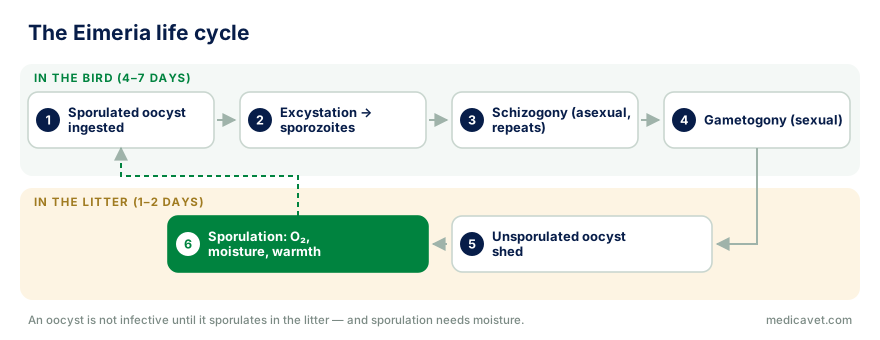
The cycle begins with a sporulated oocyst in the environment, which the bird picks up from the litter.
- Ingestion and excystation. Mechanical and enzymatic action in the gizzard and intestine opens the oocyst, releasing sporozoites.
- Schizogony (asexual multiplication). Sporozoites enter intestinal epithelial cells and divide into large numbers of merozoites. The cell ruptures and the merozoites invade fresh cells. This stage repeats several times and is the source of most tissue damage. A single oocyst can therefore destroy a great many cells.
- Gametogony (sexual multiplication). After a number of cycles, merozoites develop into male and female forms which fuse to produce a zygote.
- Oocyst shedding. The zygote lays down a resistant wall and is passed in the faeces as an unsporulated oocyst.
- Sporulation. In the environment the oocyst needs oxygen, moisture and a suitable temperature to become infective. Under favourable conditions this typically takes 1–2 days.
The complete cycle usually takes 4–7 days depending on species.
Step five is the one that matters most for management: an oocyst is not infective until it has sporulated in the house. Because sporulation requires moisture, keeping litter dry lowers coccidial pressure directly. Wet litter and a leaking drinker line create the most favourable conditions coccidiosis can ask for.
Clinical picture
Heavy infections show as bloody or mucoid diarrhoea, ruffled feathers, depression, and falling feed and water intake. With E. tenella the caecal blood is obvious.
In the field, however, the greater economic loss is usually subclinical: no obvious disease, but damaged absorptive surface causing poorer feed conversion, reduced flock uniformity and slower growth. In this form the diagnosis only emerges through post-mortem examination and lesion scoring.
A second consequence is that damaged intestinal epithelium opens the door to other agents; necrotic enteritis associated with Clostridium perfringens is the well-known example.
The principles behind control
The aim in coccidiosis is not eradication, which is not achievable in practice. The aim is to hold challenge at a level the bird can develop immunity against.
Birds do develop immunity to Eimeria, but it is species-specific and it is built by continuous low-level exposure. The pillars of management are:
- Litter management. Dry litter limits sporulation. Drinker line leaks, ventilation and litter depth all serve this end directly.
- Cleaning and downtime. Oocysts are hardy in the environment and resistant to many disinfectants, which is why mechanical cleaning and downtime between crops matter.
- Stocking density: higher density raises the oocyst load per unit area.
- A control programme. In-feed coccidiostats and coccidiosis vaccines are planned according to region and production type. Selecting and rotating that programme is a veterinary decision and is subject to the regulations in your country.
If you suspect coccidiosis in a flock, the diagnosis needs confirming by post-mortem and lesion assessment. Take programme decisions with the veterinarian who knows the flock.
References
- Swayne D.E. (ed.), Diseases of Poultry, Wiley-Blackwell
- McDougald L.R., Coccidiosis, in Diseases of Poultry
- WOAH, Terrestrial Manual: Coccidiosis
Educational only; not a diagnosis, treatment or dosage recommendation.