















Respiratory disease in poultry: a differential table
Respiratory signs in poultry can come from many different agents. CRD (Mycoplasma), IB, ILT and ND are compared here by speed of spread, flock distribution and the character of the lesions.
Last updated:
This content is for education and information only. It is not a diagnosis, treatment or dosage recommendation and does not replace examination by a veterinarian. For treatment decisions, consult your veterinarian and the product’s approved label.
Coughing, rales, nasal discharge and facial swelling are shared by many different agents in poultry. Differentiating respiratory conditions therefore means looking beyond the signs themselves at how fast it spread, how it is distributed through the flock, the mortality rate and the character of the lesions.
The table below is intended to guide a first assessment in the field. A definitive diagnosis requires laboratory confirmation.
Comparison
| Feature | CRD (Mycoplasma gallisepticum) | Infectious bronchitis (IB) | Infectious laryngotracheitis (ILT) | Newcastle disease (ND) |
|---|---|---|---|---|
| Agent | Bacterium (no cell wall) | Coronavirus | Herpesvirus | Paramyxovirus |
| Speed of spread | Slow, insidious | Very fast | Moderate | Fast |
| Mortality | Low if uncomplicated | Low–moderate | Variable, high in severe form | Can be very high, strain-dependent |
| Distinguishing feature | Sinus swelling, protracted course | Egg quality loss, renal form | Bloody mucus, open-mouth breathing | Nervous + enteric signs |
| Vertical transmission | Yes | No | No | No |
| Notifiable | No | No | Country-dependent | Yes |
What distinguishes each agent
CRD (Mycoplasma gallisepticum). Mycoplasmas have no cell wall, which is exactly why antibiotics targeting the cell wall have no effect on them (see How antibiotics work). The course is insidious, spreading through a flock over weeks. Its most important property is vertical transmission: it passes from breeder to chick through the egg, so control has to start at breeder level. Mortality alone is low, but combined with E. coli the picture becomes severe.
Infectious bronchitis (IB). A coronavirus, and extremely fast: a whole flock can be affected within days. Beyond respiratory signs it has two important consequences: loss of shell and internal egg quality in layers (misshapen, thin-shelled eggs, watery white), and renal involvement with some strains. In very young chicks, permanent oviduct damage can later produce the “false layer” picture.
Infectious laryngotracheitis (ILT). A herpesvirus. In its severe form bloody mucus accumulates in the trachea; birds extend the neck and breathe open-mouthed, and may cough blood. Because it is a herpesvirus, recovered birds can remain latent carriers and shed again under stress. This explains why the disease recurs on a site.
Newcastle disease (ND). Depending on strain, the picture ranges from very mild to devastating. What sets it apart is that respiratory signs may be accompanied by nervous signs (torticollis, paralysis, loss of balance) and greenish diarrhoea. ND is notifiable in many countries, meaning suspicion must be reported to the competent authority. That obligation varies by country and you need to know the rules that apply to you.
Questions that narrow the field
In practice these questions sharpen the differential quickly:
- How fast did it spread? The whole flock in a day or two, or over weeks? Rapid spread suggests a virus; an insidious course suggests mycoplasma.
- What is the mortality? High and sudden mortality raises severe viral pictures such as ND.
- Is egg production or quality affected? One of the most typical markers of IB.
- Are there nervous signs? If so, ND must be considered as a priority.
- What is the flock’s vaccination history? An unexpected picture in a vaccinated flock also suggests an application or timing problem (see How vaccines work).
The common denominator: the environment
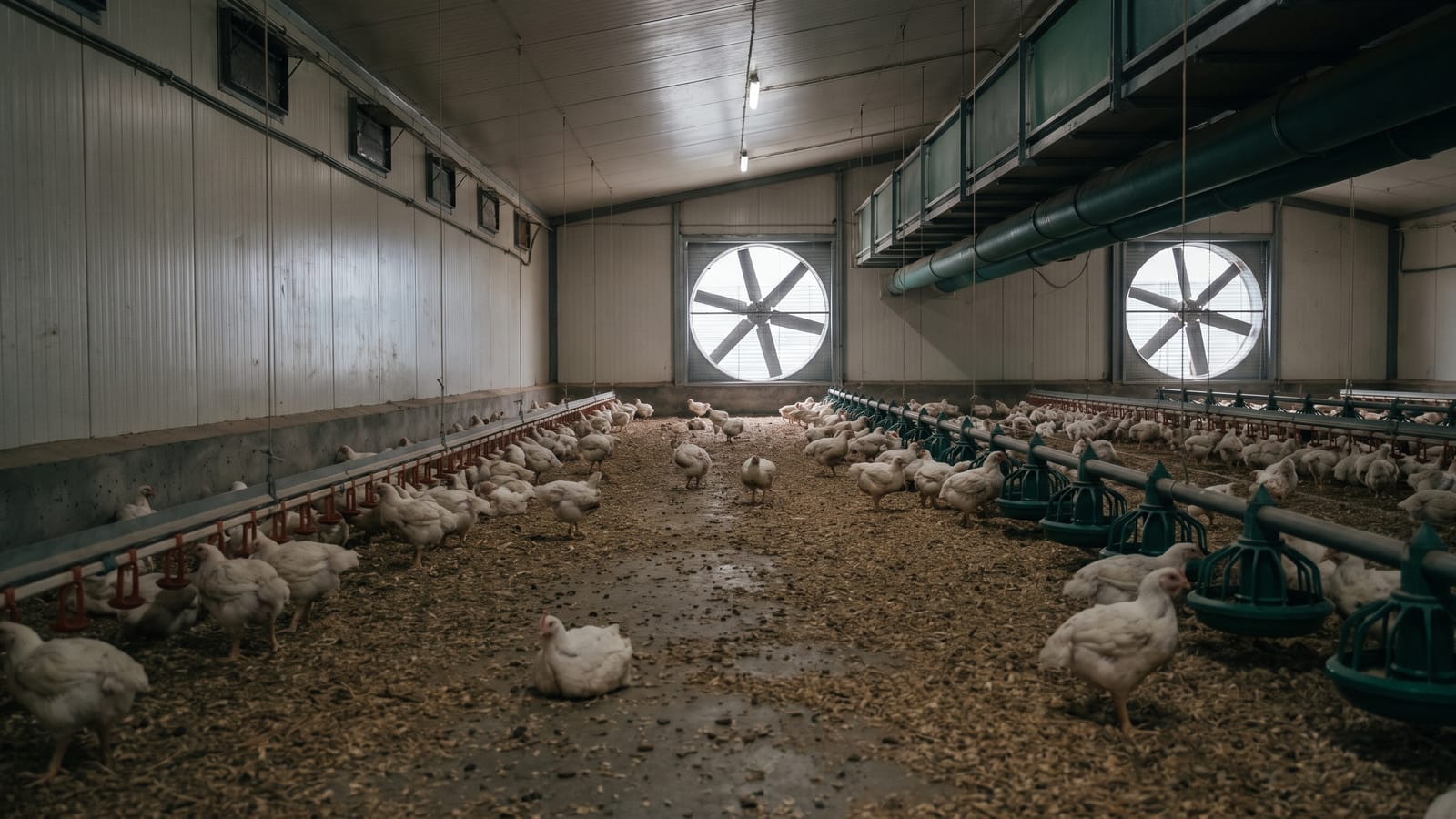
For every one of these agents, environmental conditions make the picture worse. High ammonia damages the tracheal cilia directly and makes colonisation easier. Dust, high stocking density and poor ventilation act in the same direction. Assessing a respiratory problem therefore has to include reviewing ventilation and litter management.
Where respiratory signs are seen, the diagnosis needs laboratory confirmation. Work through the assessment, and any notification obligation, with the veterinarian who knows the flock.
References
- Swayne D.E. (ed.), Diseases of Poultry, Wiley-Blackwell
- WOAH, Terrestrial Manual: Avian mycoplasmosis, Infectious bronchitis, Newcastle disease
Educational only; not a diagnosis, treatment or dosage recommendation.