















How antibiotics work: five targets, five classes
Antibiotics attack structures that bacteria have and the host animal does not. This article covers the five main targets (cell wall, protein synthesis, nucleic acids, the folate pathway and the cell membrane) and the antibiotic classes that hit each one.
Last updated:
This content is for education and information only. It is not a diagnosis, treatment or dosage recommendation and does not replace examination by a veterinarian. For treatment decisions, consult your veterinarian and the product’s approved label.
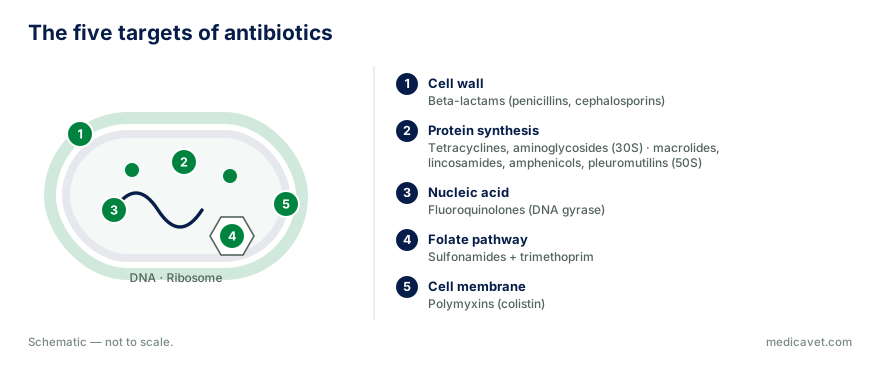
How antibiotics work: five targets
A useful antibiotic has to damage the bacterium without damaging the host. That property is called selective toxicity. It exists because bacteria carry structures that animal cells either lack entirely or build differently.
Almost every antibiotic in clinical use attacks one of five targets. Once you know which group a drug belongs to, it becomes much easier to see why it works against some bacteria and not others, and how resistance arises.
1. Cell wall synthesis
Most bacteria carry a rigid wall of peptidoglycan outside the cell membrane, and that wall holds the cell together against high internal pressure. Animal cells have no equivalent, which makes it an ideal target.
Beta-lactams (penicillins, cephalosporins, amoxicillin and relatives) block the enzymes that cross-link the peptidoglycan strands. A growing bacterium cannot repair its wall. It bursts under its own internal pressure. Beta-lactams are therefore usually bactericidal, and they only work on bacteria that are actively dividing.
Resistance to this group classically comes from beta-lactamase: the bacterium produces an enzyme that breaks the antibiotic’s ring structure open.
2. Protein synthesis
Bacteria build proteins on a 70S ribosome; animal cells use an 80S ribosome. That structural difference underpins the largest group of antibiotics.
The subgroups are defined by which ribosomal subunit they bind:
- Tetracyclines (doxycycline, oxytetracycline, chlortetracycline) bind the 30S subunit and block the incoming amino acid.
- Aminoglycosides (neomycin, gentamicin) also bind the 30S subunit, but they cause the genetic code to be misread.
- Binding to the 50S subunit stalls the growing protein chain, which is the route taken by the macrolides (tylosin, erythromycin, tilmicosin), lincosamides (lincomycin), amphenicols (florfenicol) and pleuromutilins (tiamulin).
Most of this group is bacteriostatic. It stops bacteria multiplying rather than killing them, and the clearing-up is left to the immune system. In an immunosuppressed animal the response can therefore be weaker.
3. Nucleic acid synthesis
Bacterial DNA has to be unwound and rewound during division. The enzymes that do this are DNA gyrase and topoisomerase IV.
Quinolones and fluoroquinolones (enrofloxacin, danofloxacin, marbofloxacin, flumequine) block those enzymes. The DNA cannot be replicated and the bacterium dies, so this group is bactericidal.
In many countries fluoroquinolones are listed as critically important antimicrobials, which means their use is expected to be deliberately restricted.
4. The folate pathway
Most bacteria must synthesise their own folate to build DNA precursors; animals take folate in ready-made from the diet. That difference gives another selective target.
Sulfonamides block one step of the pathway and trimethoprim blocks the next. The two are consequently formulated together very often: cutting the same chain in two places gives a stronger result than either alone, and it slows the emergence of resistance. The principle is called synergy.
5. The cell membrane
The last group attacks the bacterial outer membrane directly. Polymyxins (colistin) bind the lipopolysaccharide of the gram-negative outer membrane and disrupt its permeability, so the cell contents leak out.
Colistin is a last-line option in human medicine, and many countries specifically restrict its use in animals for that reason.
Summary
| Target | Example classes | Effect |
|---|---|---|
| Cell wall | Penicillins, cephalosporins | Bactericidal |
| Protein synthesis (30S) | Tetracyclines, aminoglycosides | Mostly bacteriostatic |
| Protein synthesis (50S) | Macrolides, lincosamides, amphenicols, pleuromutilins | Mostly bacteriostatic |
| Nucleic acid | Fluoroquinolones | Bactericidal |
| Folate pathway | Sulfonamides + trimethoprim | Bactericidal in combination |
| Cell membrane | Polymyxins | Bactericidal |
Why one antibiotic does not work on every bacterium
For an antibiotic to work it has to reach its target and the target has to be there. Gram-negative bacteria have an extra outer membrane that keeps many molecules out. Mycoplasmas have no cell wall at all, and beta-lactams, whose target is the wall, therefore have no effect on them.
Which antibiotic is appropriate in a given case depends on the organism, the animal species, how the drug distributes in the body, and what is authorised in your country. That decision belongs to the veterinarian who examines the animal.
For how resistance develops and what slows it down, see What is antimicrobial resistance (AMR)?
References
- Giguère S. et al., Antimicrobial Therapy in Veterinary Medicine, Wiley-Blackwell
- WOAH, Terrestrial Animal Health Code, Chapter 6.10: Responsible and prudent use of antimicrobial agents
Educational only; not a diagnosis, treatment or dosage recommendation.