















The ABC of pharmacokinetics: absorption, distribution, metabolism, excretion
What happens to a medicine after it enters the body falls into four stages: absorption, distribution, metabolism and excretion. This article explains ADME and why the withdrawal period follows directly from it.
Last updated:
This content is for education and information only. It is not a diagnosis, treatment or dosage recommendation and does not replace examination by a veterinarian. For treatment decisions, consult your veterinarian and the product’s approved label.
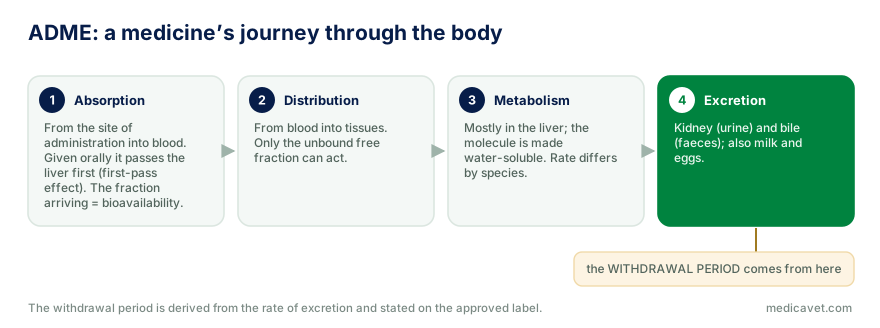
For a medicine to work it is not enough to be the right molecule: it has to reach the target tissue, in sufficient quantity, for long enough. The discipline that studies that journey is pharmacokinetics. It is summarised in four stages: absorption, distribution, metabolism, excretion, or ADME.
Absorption
Absorption is the passage of the drug from the site of administration into the bloodstream. The route of administration governs this stage directly.
With intravenous administration there is no absorption phase at all; the drug enters circulation immediately. Intramuscular and subcutaneous routes absorb more slowly but usually completely. With oral administration (as with products given in drinking water or feed in poultry) the drug must first pass through the digestive tract.
Several variables come into play by the oral route: stomach acid can degrade some molecules, minerals in feed such as calcium can bind certain antibiotics and reduce uptake, and whatever is absorbed travels from the gut straight to the liver. The liver processing part of the dose before it ever reaches general circulation is called the first-pass effect.
How much of the administered dose actually reaches systemic circulation is its bioavailability. Different formulations of the same active substance can differ in bioavailability. Formulation development matters for exactly this reason.
Distribution
Once in the blood, the drug distributes into tissues. That distribution is not even.
The determining factors include how well a tissue is perfused, how fat-soluble the drug is, and how much of it binds to plasma proteins. Only the unbound (free) fraction can cross into cells and exert an effect.
Some sites are particularly hard to reach: the central nervous system, the eye, the udder, and parts of the lung. This is sometimes why a drug that tests as effective against a “susceptible” organism does not perform as expected in the field: the concentration that worked in the laboratory is not being achieved in the tissue where the infection sits.
Metabolism
The body generally converts foreign molecules into more water-soluble forms so they can be eliminated. Most of this work happens in the liver.
Metabolism does not always mean inactivation. Some drugs are converted into metabolites that are still active; others are given in an inactive form and converted into the active one in the body (a prodrug).
The rate of metabolism differs markedly between species. That is one of the main reasons a product developed for one species cannot simply be carried across to another, and why off-label use requires a veterinarian’s judgement.
Excretion
The final stage is elimination of the drug and its metabolites. The main routes are the kidneys (urine) and bile (faeces). In lactating animals milk is also a route of excretion, as is the egg in laying birds. That is exactly where the withdrawal period comes from.
The time taken for the amount of drug in the body to fall by half is its half-life. Dosing intervals are largely derived from it.
What is the withdrawal period?
The withdrawal period is the time that must pass after the last administration before residue levels in meat, milk or eggs from that animal fall below the legally accepted safe limit.
It is not an estimate. During registration, residue concentrations in tissues are measured over time after the product is given to the target species; a safety margin is added to the result, and the figure appears on the approved label.
Failing to respect it has two consequences: a food-safety residue risk, and, for exporters, the risk of a rejected consignment. Note that the period can differ by country and product; what applies is the approved label in that market.
Why this matters
Understanding ADME answers several questions that come up regularly in the field: why the injectable and oral forms of the same active substance behave differently, why some products should not be given with feed, and why a programme set for one species cannot be transferred to another.
Decisions on dose, dosing interval and withdrawal period belong to the veterinarian examining the animal and to the product’s approved label. This article only sets out the process those decisions rest on.
References
- Riviere J.E., Papich M.G., Veterinary Pharmacology and Therapeutics, Wiley-Blackwell
- EMA, Guideline on determination of withdrawal periods for edible tissues
Educational only; not a diagnosis, treatment or dosage recommendation.